
Walk into any kiosk in Nairobi’s Eastleigh, any duka in Dar es Salaam’s Kariakoo, or any small shop in Kampala’s Owino Market on a warm afternoon and you will find the same thing: people reaching for a cold, fruit-flavoured drink. Instant fruit powder drinks have become the everyday affordable refreshment across East and Central Africa, and the market for them is growing every year as urban populations expand and consumer purchasing power increases.
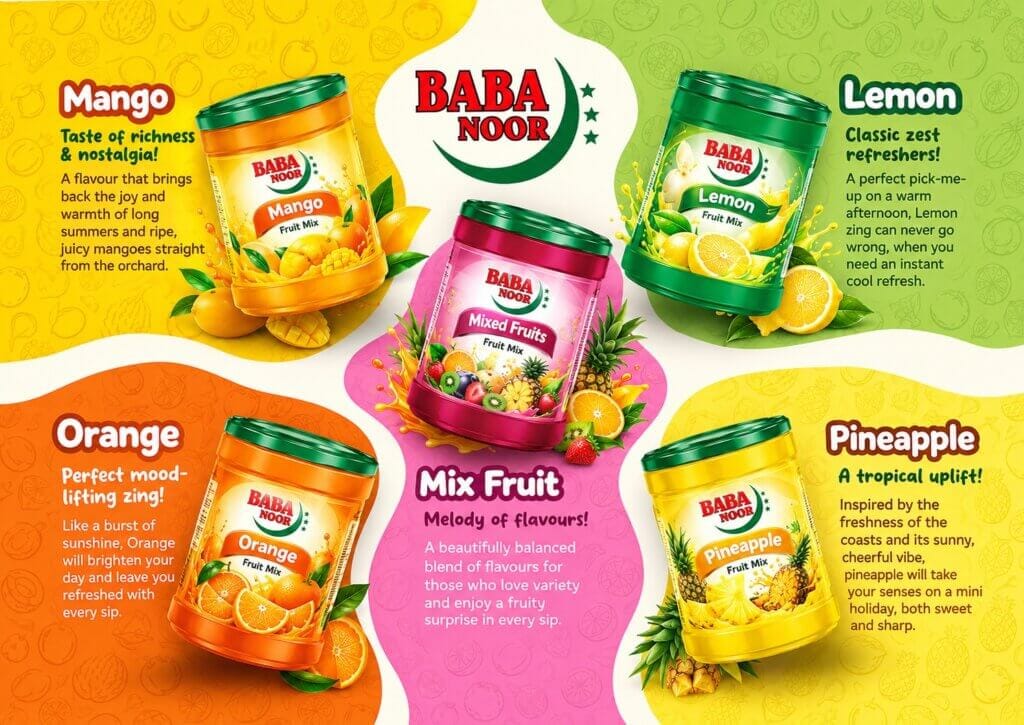
Baba Noor Fruit Mix is an instant fruit drink powder available in five flavours, Mango, Lemon, Orange, Pineapple, and Mixed Fruit, supplied by Asia & Africa General Trading FZE LLC from Dubai to wholesale importers, distributors, and retail buyers across East Africa. The brand is halal certified, vibrant in packaging, and priced for the African wholesale and retail market.
If you are a distributor or importer in Kenya, Tanzania, Uganda, Ethiopia, Djibouti, Zanzibar, Rwanda, Congo, or anywhere across East and Central Africa, contact us for current pricing and shipment details.
Submit Your Details to Receive a Personalized Quote
The Five Flavours
Mango – Taste of Richness and Nostalgia Mango is consistently the top-selling fruit flavour across East Africa. It is familiar, universally loved, and carries the warmth and richness of the tropical fruits that East Africans grow up with. Baba Noor Mango Fruit Mix delivers a full, sweet mango flavour that reconstitutes smoothly in cold or warm water. In Nairobi, Kampala, and Dar es Salaam, mango-flavoured drinks outsell every other fruit variety at the retail level.
Lemon – Classic Zest Refresher Lemon is the fastest pick-me-up in the Baba Noor range. The sharpness of lemon cuts through heat and fatigue in a way that sweeter flavours cannot, and it is particularly popular in hot coastal markets like Mombasa, Zanzibar, and Djibouti where the combination of humidity and heat drives demand for something genuinely cooling. Lemon also works well as a base for mixed drinks in food service settings.
Orange – Mood-Lifting Zing Orange is a consistent seller across all ages and income brackets. Children drink it at school. Adults mix it at home. Food service operators use it at events and catering. The Baba Noor Orange Fruit Mix has the bold, familiar orange character that performs well on retail shelves and in wholesale distribution across East Africa’s informal and formal trade channels.
Pineapple – Tropical Uplift Pineapple is a strong performer in East African markets where the fruit itself is widely grown and consumed. Uganda, Tanzania, and Rwanda all have significant domestic pineapple production, which means consumers in those markets have a calibrated expectation of what pineapple should taste like. Baba Noor Pineapple Fruit Mix delivers the sweet-sharp tropical character that East African consumers recognise. It also performs particularly well in Zanzibar, where the island’s spice and fruit trading heritage makes tropical flavour combinations natural territory.
Mixed Fruit – Melody of Flavours The Mixed Fruit variant is the choice for buyers who want variety in a single SKU. It combines a balanced blend of fruit flavours that changes the experience with each serving, making it the right choice for households that want variety, for food service operators who want a single stock item that serves the widest range of customer preferences, and for markets where buyers are exploring the product range for the first time and want one tin that gives them the full experience.
Why Instant Fruit Drink Powder Has a Strong and Growing Market in East Africa
The Middle East and Africa fruit concentrate market was calculated to be USD 2.16 billion in 2025 and is anticipated to grow to USD 3.41 billion by 2034, advancing at a compound annual growth rate of 5.23 percent during the forecast period. Instant fruit drink powder sits within this broader fruit beverage trend, and it holds a specific structural advantage in the East African market that other beverage formats do not.
Instant powder requires no refrigeration. It has a long shelf life. It can be mixed in any quantity from a single glass to a large jug, which matters for both household and catering buyers. It is significantly cheaper per serving than bottled juice or carbonated drinks, making it accessible across the full income range that East African retail serves. And it does not require the cold chain infrastructure that fresh juice or RTD (ready-to-drink) beverages need, which is a practical advantage in markets where electricity supply is intermittent and cold storage is expensive.
Sudan, Nigeria, and Ethiopia have emerged as the continent’s largest soft drink consumers by volume, with Ethiopia consuming 9.5 billion litres in 2024 alone. The broader beverage appetite across this region is enormous, and instant fruit powder captures the budget-conscious segment of that appetite more effectively than any other format.
Kenya specifically functions as the primary distribution hub for East and Central Africa. Kenya serves as a key distribution hub within East Africa, with Uganda, Tanzania, and the Democratic Republic of the Congo constituting the primary export destinations for food and beverage products distributed from Kenya. For importers who receive Baba Noor through Mombasa Port, the same container can supply Kenya’s domestic market and feed into the Uganda, Tanzania, and DRC secondary markets through Kenya’s established overland distribution networks.
Market Overview by Country
Kenya
Kenya is East Africa’s most developed consumer market and the primary entry point for imported food and beverage products destined for the wider region. Nairobi, Mombasa, Kisumu, and Nakuru all have established wholesale distribution networks. The formal retail sector, including Nairobi’s supermarket chains such as Naivas, QuickMart, and Carrefour, increasingly carries imported food and beverage brands alongside the informal kiosk and duka trade that remains the dominant retail channel by volume. Baba Noor’s vibrant packaging and five-flavour range is well-suited to both channels.
Tanzania
Tanzania’s urban centres, Dar es Salaam, Mwanza, Arusha, and Dodoma, have active wholesale and retail markets. Dar es Salaam’s Kariakoo market is one of East Africa’s largest wholesale trading hubs and a primary distribution point for goods moving into the Tanzanian interior and toward the DRC, Zambia, and Malawi. Importers based in Dar es Salaam who stock Baba Noor can supply both the urban consumer market and the inland wholesale network simultaneously.
Uganda
Kampala’s Owino and St. Balikuddembe markets, along with the wholesale trading districts of Kikuubo Street, distribute goods across Uganda and into South Sudan, eastern DRC, and Rwanda. Uganda’s young, urban-leaning population has an appetite for affordable flavoured beverages, and the country’s position at the centre of East Africa’s overland trade network makes it a natural secondary distribution hub.
Ethiopia
Ethiopia consumed 9.5 billion litres of soft drinks in 2024, making it one of the continent’s largest beverage consumers. The country’s population of approximately 130 million people, the largest in East Africa, combined with Addis Ababa’s rapidly growing urban middle class and the expanding commercial infrastructure across secondary cities, creates an enormous and underserved market for affordable fruit-flavoured beverages. Instant powder is particularly well-suited to the Ethiopian market because it bypasses the cold chain challenges that limit RTD beverage distribution outside major urban centres. Ethiopian buyers import through Djibouti Port, and our existing Djibouti supply corridor makes this a natural extension of relationships we already have in that market.
Djibouti
Djibouti is both a consumer market and a critical transit corridor. The country’s population of approximately one million is supplemented by a significant international military and logistics workforce, and the country’s role as the primary import gateway for Ethiopia means goods clearing Djibouti Port reach Addis Ababa within 3 to 5 days. Importers in Djibouti who stock Baba Noor serve both the domestic Djiboutian retail market and the Ethiopian demand that flows through this corridor.
Zanzibar
Zanzibar’s tourism-driven economy and its deep Arab and Swahili cultural heritage create a specific consumer market for halal-certified, flavoured beverages. The island’s resort hotels, local restaurants, schools, and household market all represent demand. Baba Noor’s halal positioning and tropical flavour range, particularly Mango and Pineapple, are well-matched to Zanzibar’s consumer preferences. Zanzibar importers source primarily through Dar es Salaam, making Tanzania-based distributors the natural route to this market.
Rwanda
Rwanda’s rapid economic development, strong urban growth in Kigali, and the government’s emphasis on domestic food safety standards have created an active imported food and beverage market. Kigali’s supermarkets, convenience stores, and the growing food service sector around the city’s hotel and tourism infrastructure all represent buyers for well-presented, halal-certified fruit drink products. Rwanda sources primarily through Mombasa and Uganda’s Kampala corridor.
Congo (DRC)
The DRC has a population approaching 110 million people, making it one of Africa’s largest potential consumer markets for affordable food and beverage products. Kinshasa, Lubumbashi, and Goma are the primary commercial centres. Imported food and beverage products, including instant drink powders, are distributed through wholesale networks that receive goods primarily via Dar es Salaam and Mombasa by road, and through Matadi Port for western DRC. The combination of population size, a beverage-oriented consumer culture, and limited domestic production of fruit-flavoured drink powders makes DRC one of the highest-potential markets for Baba Noor in the region.
What Makes Baba Noor the Right Product for East African Wholesale Buyers
Halal certification is non-negotiable across the Muslim-majority markets of East Africa. Djibouti, the Swahili Coast, Zanzibar, coastal Kenya and Tanzania, and the large Muslim populations of Uganda and Ethiopia all require halal-certified food and beverage products. Baba Noor carries halal certification, which removes a compliance barrier that prevents non-certified products from entering a significant share of East Africa’s retail and food service market.
Five flavours in one brand simplifies wholesale purchasing. A distributor who stocks Baba Noor carries five distinct SKUs under a single brand relationship, a single supplier, and a single import documentation process. This is more efficient than sourcing five different brands and managing five different supplier relationships for the same shelf space.
Vibrant, consumer-facing packaging is not a marketing afterthought in the East African retail context. Kiosk owners, duka operators, and market traders make stocking decisions partly based on how products look on a shelf and how effectively they attract a customer’s attention. Baba Noor’s bright, fruit-photographed packaging is designed for exactly this environment.
Powder format advantages include shelf life that makes it practical for distributors operating in markets without consistent cold storage, flexibility in serving size from a single glass to a large batch for catering, and cost per serving that is significantly lower than bottled juice alternatives, making it accessible to the mass market.
Who Should Be Contacting Us About Baba Noor
Wholesale importers in Mombasa, Dar es Salaam, Kampala, Addis Ababa, Djibouti, Kigali, Kinshasa, and Zanzibar who supply the fast-moving consumer goods (FMCG) market across their respective countries and regions.
Supermarket and retail chain buyers who are looking for a well-packaged, multi-flavour fruit drink powder range to stock alongside existing beverage products.
Food service distributors supplying hotels, schools, catering companies, and event caterers who need an affordable, bulk-purchase fruit drink solution for large-scale beverage preparation.
Secondary wholesale traders who move goods from Nairobi, Kampala, or Dar es Salaam into smaller towns, border markets, and the inland trade networks that reach rural consumers across East and Central Africa.
Asia & Africa Foodstuff Trading: Two Decades of Dubai Heritage
Get in Touch
For inquiries and booking:
– WhatsApp or Call: +971 55 956 9371
– Email: sales@agro-factory.com
– Head Office: Al Ras Market, Dubai – UAE
Frequently Asked Questions
Is Baba Noor Fruit Mix halal certified?
How is Baba Noor Fruit Mix prepared?
What pack sizes are available?
Can I import multiple flavours in a single container?
What is the minimum order quantity?
Which port should I import through?
Where is Asia & Africa General Trading located?
Our office is located in Dubai, at Al Shizawi Building – Al Ahmadiya St – Deira – Al Ras(Near Al Ras Metro Station). You can easily find us on Google Maps or contact us directly for any assistance you may need in finding us. We look forward to serving you!
Other Products We Supply to East Africa
Asia & Africa General Trading supplies a full range of food commodities to East African importers alongside Baba Noor Fruit Mix.
Day to Day Corn Starch from India is available CIF Djibouti at USD 556 per metric ton, with 15-day shipment from India. Day to Day PK 386 White Rice 5% Broken from Pakistan is available CIF Mogadishu at USD 889 per metric ton. Day to Day Free Flow Iodised Salt from India is available CIF Djibouti at USD 177 per metric ton. Red split lentils oil polish from Turkey are available CIF Port Sudan at USD 770 per metric ton and CIF Mombasa at USD 878 per metric ton.
For buyers who import multiple food products, consolidating Baba Noor with other commodity lines in a single container reduces per-MT freight cost across the full order.