Salt is the one commodity that every household, every food manufacturer, and every food preservation operation in Africa cannot function without. It is not a seasonal purchase or a discretionary import. It moves year-round, in volume, through the wholesale chains that supply open markets, factories, fishing communities, and institutional kitchens from the Horn of Africa to the Gulf of Guinea.
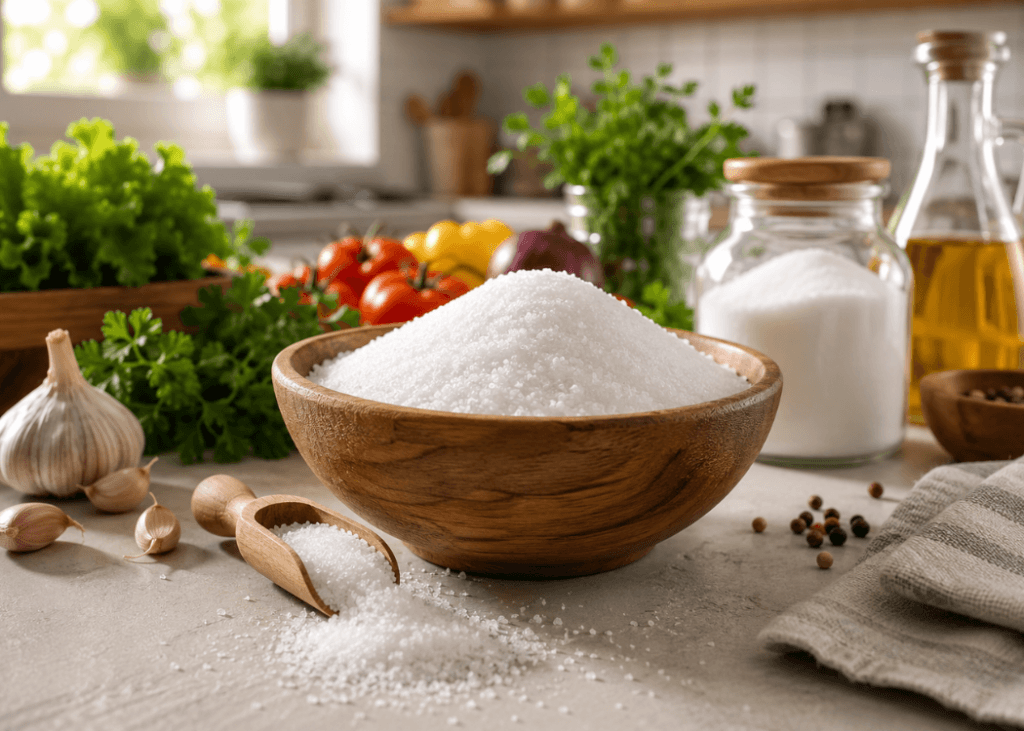
Asia & Africa General Trading FZE LLC is offering Day to Day Free Flow Iodised Salt from India at USD 177 per metric ton, delivered CIF to Djibouti Port, Lome Port (Togo), and Tema Port (Ghana), with August 2026 shipment from India. The product is packed in 25 kg PP bags, with 28 metric tons loading per container, and is specifically formulated with iodine fortification for markets where iodine deficiency remains a public health consideration.
Submit Your Details to Receive a Personalized Quote
Product Specifications
Brand: Day to Day
Product: Free Flow Iodised Salt
Origin: India
Packing: 25 kg PP bag
Loading: 28 metric tons per 20-foot container
Price: USD 177 per metric ton
Delivery: CIF Djibouti Port / CIF Lome Port, Togo / CIF Tema Port, Ghana
Shipment: August 2026 from India
Status: Booking open now
What Free Flow Iodised Salt Means for Buyers
The term free flow refers to the anti-caking agents added to the salt during processing to prevent the crystals from clumping in humid conditions. In tropical and equatorial climates, standard salt without anti-caking treatment tends to solidify in the bag during storage and transport, creating handling problems for wholesalers, retailers, and food manufacturers who need the product to pour and measure consistently.
For markets across West Africa and the Horn of Africa, where humidity is high and cold-chain storage is limited, free flow is not a premium specification. It is the baseline practical requirement that makes the product usable at every point in the supply chain.
Iodisation adds a second layer of value. Iodine deficiency is a documented public health issue across several sub-Saharan African markets, and WHO and UNICEF guidelines push for universal salt iodisation as the most cost-effective dietary iodine intervention available. Many food manufacturing and institutional procurement tenders in African markets now specify iodised salt as a requirement, not an option. Day to Day Free Flow Iodised Salt is formulated to meet that specification.
Three Ports, Three Markets
Pricing to Djibouti, Lome, and Tema simultaneously is deliberate. These three ports each sit at the top of a different regional distribution chain.
Djibouti is the entry point for the Horn of Africa. Ethiopia, with a population approaching 130 million people and essentially no sea access, receives the bulk of its food imports through Djibouti Port via the Addis Ababa corridor. Eritrea, Djibouti itself, and Somalia also source through this hub. Salt demand in Ethiopia is enormous, driven by a large food processing sector, a significant fishing industry along Ethiopian lake systems, and household consumption across a country that imports almost all of its processed salt requirements. At USD 177 per MT CIF Djibouti, Indian-origin iodised salt is highly competitive against other origins currently supplying this corridor.
Lome Port, Togo functions as the gateway for one of West Africa’s most active re-export hubs. Togo’s domestic population is small, but Lome’s port serves as the practical import point for Burkina Faso, Mali, and Niger, three landlocked Sahel nations with large populations and limited domestic salt production. Salt sourced through Lome regularly moves northward by road into Ouagadougou, Bamako, and Niamey. Burkina Faso in particular has been identified as having one of the region’s stronger demand profiles for imported iodised salt, driven by government public health programs and growing food manufacturing in Ouagadougou.
Tema Port, Ghana serves Ghana’s domestic market directly and connects into the regional wholesale network that supplies southeastern Burkina Faso, northern Togo, and parts of Benin. Ghana has an established food manufacturing sector and a supermarket retail environment that is more developed than most of its immediate neighbours. Salt demand comes from domestic household consumption, the large fishing industry along Ghana’s coast (where salt is used in fish preservation and processing), food manufacturers producing canned goods, snacks, and processed foods, and the institutional catering sector.
The Burkina Faso Angle
Burkina Faso deserves a specific mention because it regularly surprises buyers who have not looked closely at the country’s import dynamics.
A landlocked nation of approximately 23 million people, Burkina Faso imports virtually all of its processed and iodised salt. The country sits between two active port corridors, Lome to the south and Abidjan to the southwest, and buyers in Ouagadougou source through whichever port currently offers more competitive landed pricing. The August 2026 shipment window from India gives buyers in both corridors the opportunity to lock in competitively priced salt before the end-of-year seasonal demand peak, which typically accelerates across West African markets in Q4.
Who Buys Iodised Salt in These Markets
Food manufacturers are the highest-volume buyers. Biscuit factories, noodle manufacturers, bread and pastry operations, preserved meat processors, and canned food producers all require consistent, documented salt supply. For food manufacturers in Ghana, Togo, and the Ethiopian processing zones near Addis Ababa, an Indian-origin supply chain with clear documentation and stable August shipment timing is preferable to ad-hoc spot buying.
Fish processors and preservation operations along the Gulf of Guinea coast and around East African lake systems use salt at scale. Traditional salt-dried and smoked fish, which represent critical low-cost protein sources across both West and East Africa, depend on consistent salt supply. A price increase or supply disruption in salt directly impacts the economics of artisanal and semi-commercial fish preservation.
Wholesale food distributors who supply open markets, grocery stores, and smaller retail outlets across Accra, Lome, and Djibouti source salt in FCL quantities and break it down through their distribution networks. The 25 kg bag is the standard wholesale handling unit across all three markets.
Institutional buyers, including schools, prisons, hospitals, military catering, and NGO food programs, procure iodised salt specifically because of the fortification requirement. Humanitarian procurement frameworks, including those used by the World Food Programme and bilateral aid agencies operating in the Horn of Africa, frequently specify iodised salt by name.
Why India Is a Competitive Salt Origin for These Routes
India is one of the world’s largest salt producers, with production concentrated in Gujarat (Rann of Kutch), Rajasthan, and coastal Tamil Nadu and Andhra Pradesh. For the East Africa and West Africa routes, Indian salt offers several structural advantages over alternatives.
The freight routes from Gujarat ports to Djibouti are short and direct, with regular liner services making USD 177 per MT CIF Djibouti genuinely competitive on a delivered basis. For Lome and Tema, vessels from Indian ports transiting the Cape of Good Hope or through the Suez Canal have established sailing schedules that make August arrival feasible from a late July or early August loading window.
Indian salt producers have decades of export experience with WHO and UNICEF iodisation standards, and the documentation that Indian exporters provide, including certificates confirming iodine content, origin certificates, and food safety compliance, is well-understood by customs authorities at all three destination ports.
28 MT per Container
The 28 metric ton loading per 20-foot container reflects the density of 25 kg PP bags stacked to the practical limit for this packing format. For buyers calculating landed cost, this means a single 20-foot FCL carries 1,120 bags at the CIF price of USD 177 per metric ton, for a total shipment value of approximately USD 4,956 per FCL. That is a low-entry value for an FCL commodity import, which means salt is often one of the easiest products for new importers to start with, and one of the easiest for established traders to add onto a consolidated container alongside other commodities.
Asia & Africa Foodstuff Trading: Two Decades of Dubai Heritage
Get in Touch
For inquiries and booking:
– WhatsApp or Call: +971 55 956 9371
– Email: sales@agro-factory.com
– Head Office: Al Ras Market, Dubai – UAE
Frequently Asked Questions
Is the salt suitable for direct human consumption or is it industrial grade?
Day to Day Free Flow Iodised Salt is food grade, formulated for direct human consumption. The iodisation meets food safety standards for dietary iodine supplementation. It is suitable for household use, food manufacturing, and institutional catering.
What iodine level is used in the fortification?
The specific iodine content per kilogram can be confirmed on the Certificate of Analysis. For buyers whose market has a regulatory minimum iodine level, contact us and we will provide the COA confirming the fortification level before you commit to the order.
Can I order combined with other products in the same container?
Yes. Salt is commonly consolidated with other food commodities in mixed FCL shipments. Combining salt with sugar, milk powder, or canned goods in one container reduces per-MT freight cost. The 28 MT capacity of a salt FCL leaves some margin for mixed loads depending on the weight profile of the other products. Contact us to discuss a consolidated booking.
Is August 2026 the only shipment window?
August 2026 is the confirmed current shipment. For buyers who need product later in Q4 2026, contact us to discuss subsequent vessel availability. All bookings are subject to confirmation at time of order.
Can you quote CIF to other ports such as Mombasa, Dakar, or Abidjan?
Yes. The published offer covers Djibouti, Lome, and Tema. We can provide CIF quotations to additional ports on request.
What documentation comes with the shipment?
Standard export package: Bill of Lading, Certificate of Origin (India), Certificate of Analysis confirming iodine content and food grade specification, commercial invoice, packing list, and phytosanitary certificate. Halal certificate available on request.
Where is Asia & Africa General Trading located?
Our office is located in Dubai, at Al Shizawi Building – Al Ahmadiya St – Deira – Al Ras(Near Al Ras Metro Station). You can easily find us on Google Maps or contact us directly for any assistance you may need in finding us. We look forward to serving you!
Also Available from Asia & Africa General Trading
Beyond iodised salt, our current offer sheet for West Africa and East Africa includes several complementary commodities that buyers at these ports frequently source together.
Day to Day Instant Fat Filled Milk Powder 28% is available at USD 1,930 per metric ton CIF Onne Port and Apapa Port in Nigeria, in 25 kg bags, fortified with vitamins A, D, E and K.
Le Pari Sardines in Vegetable Oil are available at USD 20.15 per carton (125g x 50 tins) CIF Lome Port, with 3,250 cartons per 20-foot FCL and strong demand across the ECOWAS region.
White refined sugar in multiple grades and origins, red split lentils from Turkey, and Indian-origin spices including cumin, turmeric, and chilli powder are all available on commercial terms to West African and East African ports.
For buyers at Lome, Tema, or Djibouti who source multiple product categories, consolidating with us reduces documentation complexity and freight cost per metric ton across the order.