
Baba Noor Tomato Ketchup and Day to Day Monosodium Glutamate are both available now from Asia & Africa General Trading FZE LLC for wholesale buyers, food manufacturers, retail distributors, and export traders across Africa, the GCC, and global markets.
Submit Your Details to Receive a Personalized Quote
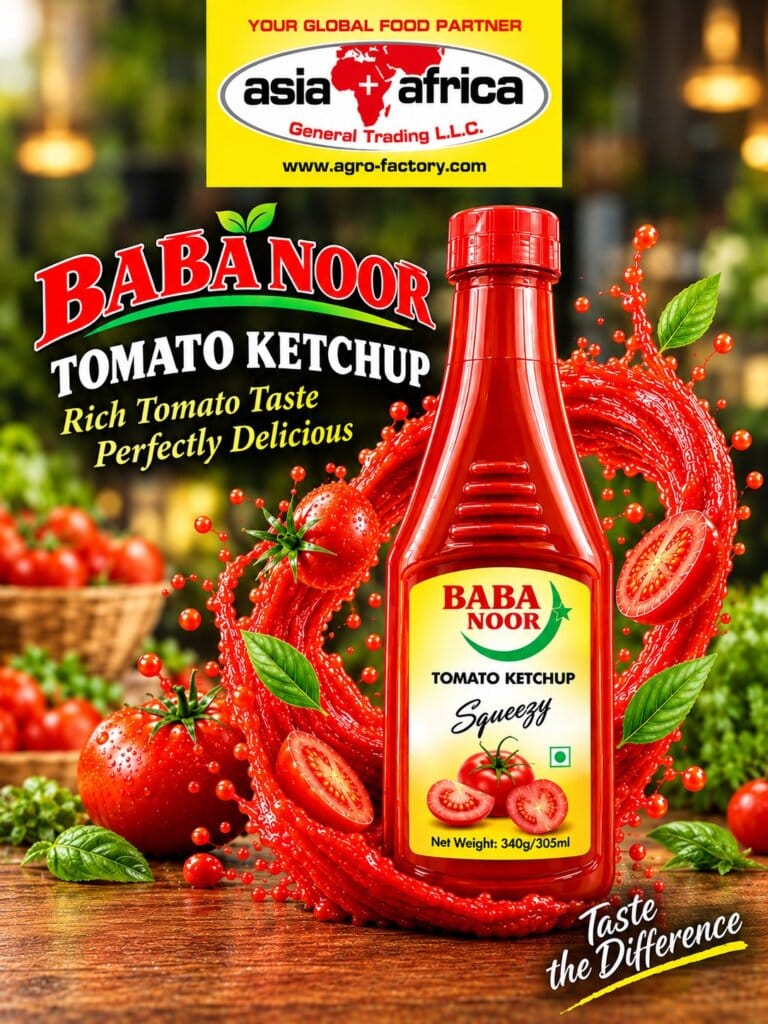
Baba Noor Tomato Ketchup — Rich Tomato Taste, Perfectly Delicious
Brand: Baba Noor
Product: Tomato Ketchup Squeezy
Net Weight: 340g / 305ml per bottle
Packaging: Squeezy bottle
Certification: Halal
What It Is and Who Buys It
Baba Noor Tomato Ketchup is a rich, thick tomato ketchup in a squeezy bottle format — the most consumer-friendly and kitchen-practical condiment format in the retail and food service trade. The squeezy bottle is what supermarkets stock, what restaurant tables carry, and what household buyers reach for because it delivers the right quantity every time without mess or waste.
Tomato ketchup is one of the most universally consumed condiments globally. In Africa, ketchup demand has grown alongside urbanisation and the rapid expansion of fast food culture. Burger joints in Lagos, shawarma shops in Nairobi, chicken restaurants in Accra, and hotel kitchens across East and West Africa all use ketchup in daily operations. Retail demand from households follows the same trajectory as rising urban incomes and changing eating patterns.
The Baba Noor brand carries a presentation that performs well on retail shelves. The yellow and red label is bold and visible, the squeezy format is familiar to consumers across Africa and the Gulf, and the halal certification removes a compliance barrier that non-certified ketchup brands face in Muslim-majority markets.
Markets for Baba Noor Tomato Ketchup
Across Africa, the markets with the clearest commercial fit for Baba Noor Ketchup are:
Nigeria — Africa’s largest consumer market with an enormous fast food and household condiment sector. Lagos, Kano, Abuja, and Port Harcourt all have active wholesale and modern retail distribution networks.
Kenya and East Africa — Nairobi’s growing supermarket sector (Naivas, QuickMart, Carrefour Kenya) and the active informal retail trade both distribute ketchup. East Africa’s food service sector, including hotels and restaurants serving the region’s significant tourism and business travel market, is a consistent ketchup buyer.
Ghana — Accra’s modern retail and fast food scene has expanded significantly. Ghanaian consumers have strong exposure to branded condiments through formal retail channels.
West Africa broadly — Senegal, Ivory Coast, Togo, Benin, and the Francophone West Africa retail market all carry tomato ketchup as a standard supermarket and grocery SKU.
GCC — UAE, Saudi Arabia, Kuwait, Qatar, and Oman all have large South Asian and Southeast Asian expatriate populations who use ketchup daily in household cooking and in the food service operations they work in and around.
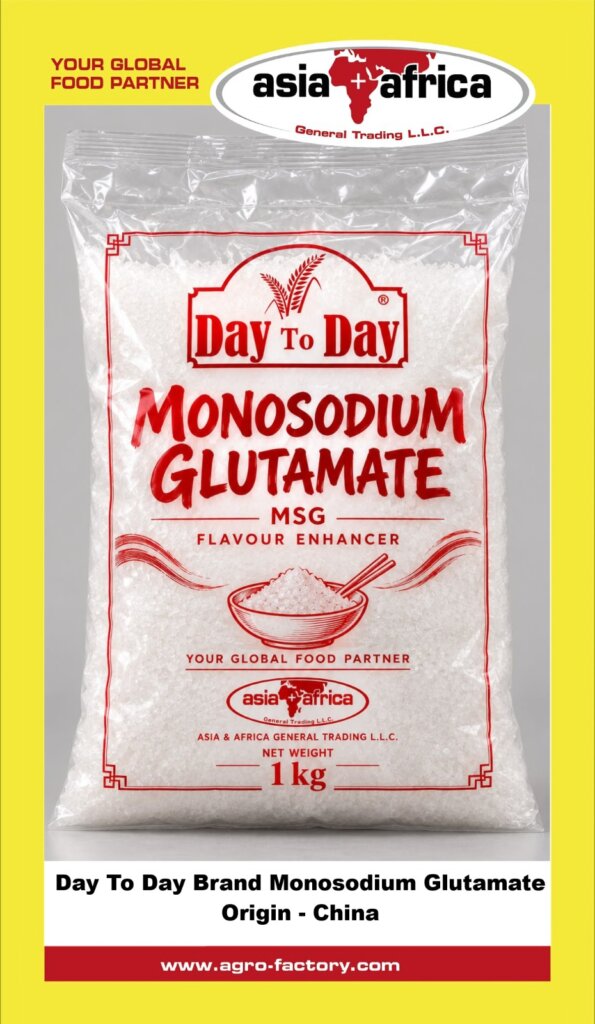
Day to Day MSG — Monosodium Glutamate Flavour Enhancer
Brand: Day to Day
Product: Monosodium Glutamate (MSG) — Flavour Enhancer
Also known as: Ajinomoto, umami seasoning
Origin: China
Available in: 500g pouch, 1 kg bag, 5 kg bag, 25 kg bag
Certification: Halal
What MSG Is and Why Global Demand Is Enormous
Monosodium glutamate is the sodium salt of glutamic acid, a naturally occurring amino acid found in tomatoes, cheese, mushrooms, and many fermented foods. When used as a food additive at very small concentrations, MSG amplifies the umami taste dimension — the savoury, meaty, full-bodied flavour that makes food taste richer and more complete without adding more salt, fat, or sugar.
The US FDA classifies MSG as Generally Recognised as Safe (GRAS). It is used in food manufacturing, restaurant kitchens, and home cooking across every continent. The E number is E621.
Day to Day MSG is available across a wide range of pack sizes, from 500 gram consumer pouches to 25 kg industrial bags, which means the same product serves the street food vendor, the household cook, the restaurant kitchen, and the food manufacturing factory depending on which pack size they order.
Who Uses MSG
Instant noodle and soup manufacturers — MSG is one of the most critical flavour ingredients in instant noodle seasoning sachets and dehydrated soup mixes. The instant noodle sector across Africa and Asia is enormous and growing.
Seasoning blend and spice mix producers — virtually every commercial savoury seasoning powder, stock cube, and bouillon tablet contains MSG or glutamate-based flavour enhancers. Manufacturers producing these across West Africa, East Africa, and the GCC are significant industrial buyers.
Restaurant kitchens and food service — Chinese restaurants, Asian food outlets, fast food chains, and commercial caterers across Africa and the Gulf use MSG as a kitchen seasoning staple.
Snack manufacturers — crisps, savoury extruded snacks, and flavoured nuts use MSG in their seasoning coatings.
Household cooking — across West Africa, particularly Nigeria, MSG (often sold under the Ajinomoto brand) is used in everyday home cooking as a standard seasoning alongside salt and pepper.
Markets for Day to Day MSG
MSG has genuinely global commercial demand. The highest-volume markets for Day to Day MSG from Asia & Africa General Trading are:
Nigeria and West Africa — MSG is a standard household seasoning in Nigeria, Senegal, Ghana, and Ivory Coast. The bulk 25 kg bag is purchased by seasoning manufacturers and industrial food companies; the 500g and 1 kg packs serve retail and wholesale channels.
East Africa — Kenya, Tanzania, Uganda, and Ethiopia all have active MSG markets, driven by Chinese restaurant culture, food manufacturing, and South Asian cooking communities.
GCC — the UAE, Saudi Arabia, and Kuwait have significant MSG demand from food manufacturers, Asian restaurant operators, and the South and Southeast Asian populations who use MSG in home cooking.
South Asia — Pakistan, Bangladesh, and India all have active commercial MSG markets for food manufacturing and food service.
North Africa — Egypt, Libya, Morocco, and Algeria have growing MSG consumption in food manufacturing and restaurant sectors.
Why Source Both from Asia & Africa General Trading
The practical case for sourcing both products from the same supplier is straightforward. One enquiry, one negotiation, one pro-forma invoice, one set of shipping documents, and potentially one container — if the order quantities support consolidated shipping, combining ketchup and MSG in a single FCL saves per-MT freight cost across both products.
For distributors who supply multiple categories to the same retail or wholesale customers, a supplier relationship that covers condiments, flavour ingredients, and staple food commodities simplifies procurement significantly.
Asia & Africa Foodstuff Trading: Two Decades of Dubai Heritage
Get in Touch
For inquiries and booking:
– WhatsApp or Call: +971 55 956 9371
– Email: sales@agro-factory.com
– Head Office: Al Ras Market, Dubai – UAE
Frequently Asked Questions
Is Baba Noor Ketchup suitable for the Nigerian and West African retail market?
Is MSG safe for use in food products?
What pack sizes are available for MSG?
Can I order Baba Noor Ketchup and MSG together in one container?
What documentation is provided?
Where is Asia & Africa General Trading located?
Our office is located in Dubai, at Al Shizawi Building – Al Ahmadiya St – Deira – Al Ras(Near Al Ras Metro Station). You can easily find us on Google Maps or contact us directly for any assistance you may need in finding us. We look forward to serving you!
Other Products We Supply to East Africa
Our current offer sheet for West African buyers covers several commodity categories alongside black pepper.
Le Pari Sardines in Vegetable Oil are available at USD 20.15 per carton (125g x 50 tins) CIF Lome. Day to Day Iodised Salt from India is available CIF Lome, Tema, and Djibouti at USD 177 per metric ton. White refined sugar in multiple grades including Brazilian IC150 is available CIF Banjul, Onne, and West African ports. Indian-origin spices including cumin seeds, coriander, turmeric powder, and chilli powder are available on commercial terms to West African ports.
For buyers who source multiple products, combining black pepper with sardines, salt, or sugar in a consolidated container reduces per-MT freight cost across the full order.