
Submit Your Details to Receive a Personalized Quote
What Rice Husk Pellets Are
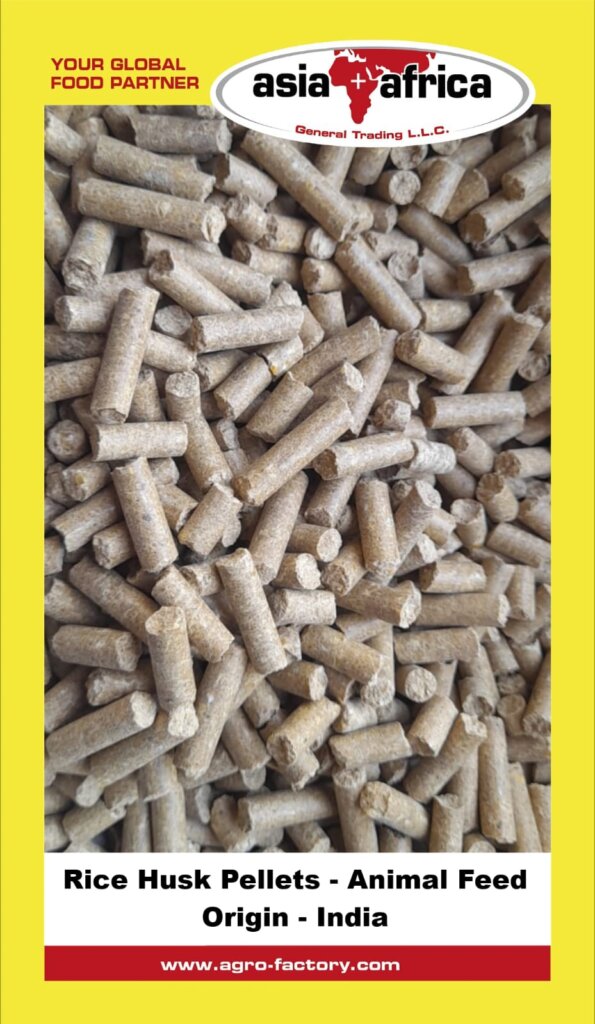
Rice husk is the hard outer shell of the rice grain that is removed during milling to produce white rice. It is the largest agricultural byproduct of rice processing globally. India, as one of the world’s top rice producing and milling nations, generates tens of millions of metric tons of rice husk annually.
In raw loose form, rice husk is bulky, low-density, and difficult to store, transport, and feed consistently. Pelleting solves all three problems simultaneously. The loose husk is ground and compressed under heat and pressure into dense cylindrical pellets that are uniform in size, easy to handle, and significantly higher in bulk density than the raw material. The pelleting process also partially breaks down the silica-bound fibre structure of the husk, improving its digestibility compared to raw loose husk.
The resulting pellet is a high-fibre, moderate-energy feed ingredient used as a roughage source and feed extender in livestock and poultry rations. It contributes dietary fibre, silica, and some carbohydrate energy to the diet, and it is most commonly used to extend more expensive feed ingredients, add bulk and physical form to feed mixes, and provide the physical roughage that ruminant digestive systems require for healthy function.
Why This Product Has Strong Demand in These Four Markets
Afghanistan
Afghanistan has one of Central Asia’s most active small ruminant livestock sectors. Sheep, goats, and cattle are central to rural Afghan livelihoods, cultural traditions, and food security. The country produces limited grain domestically and relies on imported feed ingredients to supplement livestock rations, particularly during winter months when pasture grazing is limited or unavailable.
Rice husk pellets serve the Afghan livestock market as an affordable roughage extender that can be mixed with locally sourced fodder, wheat straw, and imported grain to produce balanced feed rations at a cost that small-scale farmers and commercial feedlot operators can work with. The fact that India is geographically the most accessible bulk feed ingredient origin for Afghan importers, via Pakistan’s port network or direct overland routes, gives Indian-origin rice husk pellets a freight advantage over alternatives from more distant origins.
Kabul, Mazar-i-Sharif, and Herat are the primary distribution centres for imported agricultural commodities into Afghanistan, with goods typically entering through Karachi Port and then road-freighted across the Pakistan-Afghanistan border at the Torkham and Chaman crossings.
Pakistan
Pakistan’s livestock sector is enormous by any measure. The country has one of the world’s largest cattle, buffalo, and small ruminant populations. Dairy farming, beef production, poultry farming, and the commercial feedlot sector collectively consume millions of metric tons of feed ingredients annually.
Rice husk pellets are used across this sector as a roughage component in compound feed and as a direct-fed ingredient in feedlots where whole ruminants need physical fibre in their diet. Pakistan’s commercial poultry industry also uses rice husk pellets as a litter material as well as a minor feed ingredient in some formulations.
The scale of Pakistan’s livestock sector means that importers who establish consistent supply relationships for rice husk pellets are working with recurring, large-volume demand rather than one-off orders. Karachi Port handles the majority of Pakistan’s food and agri-commodity imports, with Lahore and Faisalabad as the primary inland distribution points for feed industry buyers in the Punjab agricultural belt.
Bangladesh
Bangladesh is a densely populated country where small-scale poultry and cattle farming is embedded in the rural economy at every level. Rice husk pellets have a natural cultural familiarity in Bangladesh because the country itself is a massive rice producer and the concept of rice byproducts being returned to the agricultural system is well understood by farmers and feed buyers alike.
Commercial poultry operations in Dhaka, Chittagong, and the surrounding agricultural districts use rice husk pellets as a cost-effective litter material and as a fibre component in some feed formulations. The cattle sector uses pellets as a roughage supplement. Importers in Chittagong, which handles the majority of Bangladesh’s container import volume, distribute feed ingredients across the country through established agri-commodity wholesale networks.
Kenya and East Africa
Kenya’s commercial livestock sector, particularly the dairy farming operations concentrated in the Rift Valley, Central Highlands, and Nakuru areas, represents the primary market in East Africa for imported feed ingredients. Commercial dairy farms producing milk for Nairobi’s processing plants and retail chains run on formulated rations that require consistent roughage supply alongside energy and protein ingredients.
Rice husk pellets serve the Kenyan market as an affordable roughage component that supplements locally available roughage sources like maize stovers, sugarcane bagasse, and Napier grass. During dry seasons when natural roughage availability is reduced, the demand for imported roughage ingredients including rice husk pellets increases accordingly.
Mombasa Port is the entry point for the majority of Kenya’s agri-commodity imports. The Northern Corridor from Mombasa connects into Uganda, Rwanda, and South Sudan, making Mombasa-based importers natural distributors for feed ingredients across the wider East Africa region. Tanzania’s commercial livestock sector, based around Arusha and Dar es Salaam, represents an additional market served through this network.
How Rice Husk Pellets Are Used in Animal Feed
The application varies across species and production systems, and understanding the use case helps buyers confirm the right specification and quantity for their customers.
In cattle and buffalo feed, rice husk pellets are incorporated as a roughage component at inclusion levels typically ranging from 10 to 25 percent of the total ration by dry matter. Ruminants need physical fibre in their diet to maintain rumen function, and rice husk pellets provide that structural fibre while adding modest energy from the carbohydrate fraction of the husk. Dairy cows in particular perform poorly on rations that lack adequate physical roughage, making imported roughage ingredients like rice husk pellets commercially important for commercial dairy operations.
In sheep and goat feed, rice husk pellets serve a similar roughage function and are widely used in Central and South Asian pastoral and semi-intensive production systems. The dense pellet format makes them easy to store and measure in small farm settings.
In commercial poultry litter, rice husk pellets and loose husk are both used as bedding materials in broiler houses. The pellet format offers better litter management properties in some operations because it maintains structure longer before composting. This is a separate application from dietary use but represents an additional buyer category.
In aquaculture feed, rice husk is used as a minor fibre component in certain extruded fish feed formulations. This is a smaller application but represents growing demand as South Asian aquaculture production expands.
India as the Right Origin for These Markets
India’s position as the world’s largest rice exporter and one of its largest rice millers means it generates the largest volumes of rice husk of any country globally. The feed-grade pelleting industry that has developed around this raw material base is mature, well-equipped, and experienced in producing consistently specified export product. For buyers in Afghanistan, Pakistan, and Bangladesh, Indian origin means short sea freight or overland transit times that reduce total landed cost relative to other origin options. For Kenyan buyers, Indian origin offers regular direct vessel services to Mombasa with established freight routes and manageable transit times of approximately 12 to 18 days. The documentation that Indian exporters provide, including Certificate of Origin, Certificate of Analysis, phytosanitary certificate, and commercial documentation, is well-understood by customs authorities in all four target markets and cleared without the complications that less-established origins can sometimes create.
Asia & Africa Foodstuff Trading: Two Decades of Dubai Heritage
Get in Touch
For inquiries and booking:
– WhatsApp or Call: +971 55 956 9371
– Email: sales@agro-factory.com
– Head Office: Al Ras Market, Dubai – UAE
Frequently Asked Questions
What is the nutritional profile of rice husk pellets for animal feed?
What packing format is available?
What is the minimum order quantity?
Can you supply CIF Karachi, CIF Chittagong, or CIF Mombasa?
Is a Certificate of Analysis provided confirming feed grade specification?
Where is Asia & Africa General Trading located?
Our office is located in Dubai, at Al Shizawi Building – Al Ahmadiya St – Deira – Al Ras(Near Al Ras Metro Station). You can easily find us on Google Maps or contact us directly for any assistance you may need in finding us. We look forward to serving you!
Other Products We Supply to East Africa
For buyers in South Asia and East Africa who import multiple agri-commodity categories, we also supply yellow maize for animal feed from our Dubai warehouse at competitive rates, as well as a full range of food commodities including rice, sugar, milk powder, lentils, and spices. Combining rice husk pellets with other commodities in a consolidated container is possible for buyers whose volume requirements per product do not fill a full FCL individually. Contact us to discuss your total requirement across multiple product lines.