
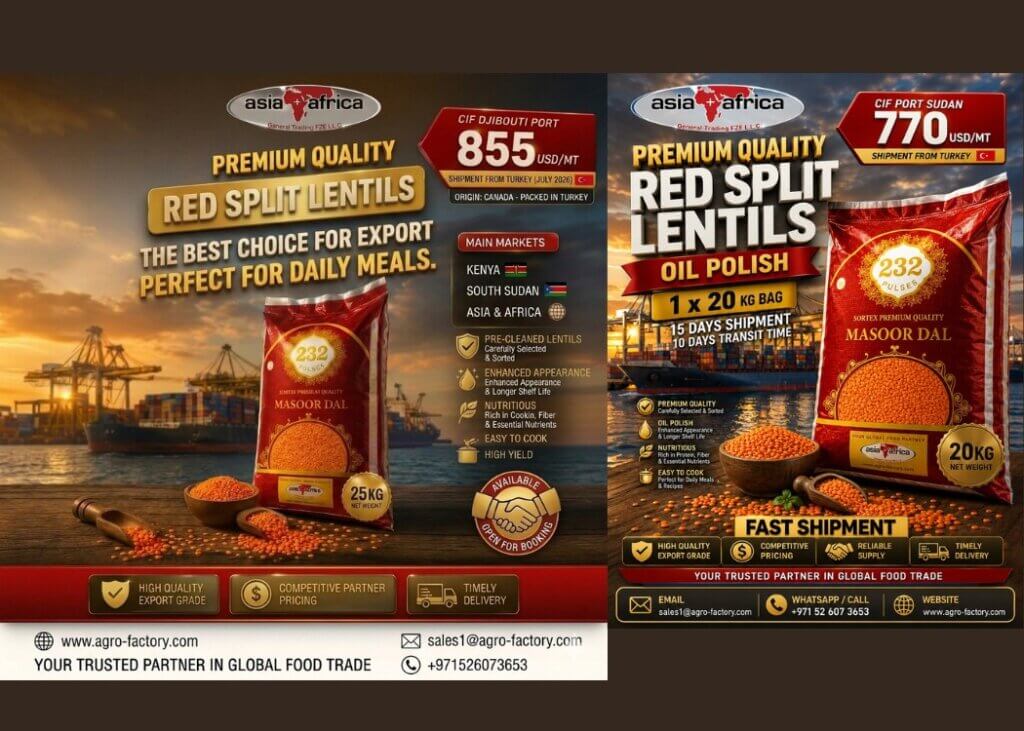
Three ports. Three price points. One reliable shipment pipeline. Asia & Africa General Trading FZE LLC has confirmed cargo availability for Premium Red Split Lentils sortex-cleaned, oil-polished (known in the trade as 232 Pulses brand Masoor Dal) loading from Turkey, with vessels reaching Mombasa, Port Sudan, and Djibouti on competitive CIF terms. Whether your team searches for red split lentils, split red lentils, dengu nyekundu (Kenya), or adas ahmar / عدس أحمر (Sudan and the Arabic-speaking market) — this is the same trusted product, ready to ship. If your business depends on a dependable pulses pipeline into East Africa or the Horn of Africa, this is the offer to lock in now — shipment slots are confirmed within 15 days of booking, with 10-day transit time, meaning lentils can be on your dock in roughly three to four weeks from the moment you place your order.
Submit Your Details to Receive a Personalized Quote
Current CIF Offers — Premium Red Split Lentils (232 Pulses Brand)
| Destination Port | Price | Packing | Origin / Processing | Notes |
|---|---|---|---|---|
| Port Sudan, Sudan | USD 770/MT | 1 × 20 kg bag | Turkey | 15-day shipment · 10-day transit · Fast lane offer |
| Mombasa Port, Kenya | USD 878/MT | 1 × 20 kg bag | Canada (origin) — Packed in Turkey | July 2026 shipment |
| Djibouti / additional Horn of Africa ports | Quote on request | 1 × 20 kg bag | Turkey | Contact for current pricing |
Brand: 232 Pulses — Masoor Dal, Sortex Premium Quality Process: Oil Polish finish for enhanced appearance and extended shelf life Net weight: 20 kg / 25 kg bag (confirm packing at time of order)
A Tale of Two Origins — Why the Same Lentil Has Two Different Stories
Buyers often assume “red split lentils” is a single uniform commodity. It isn’t. The two offers above actually represent two distinct supply chains converging at the same Turkish packing and export facility — and understanding the difference helps buyers choose the right cargo for their market.
The Port Sudan offer (USD 770/MT) moves through Turkey’s fast-lane export corridor — lentils sourced, sortex-cleaned, oil polished, and bagged in Turkey, then loaded onto vessels bound for the Red Sea and Port Sudan with a tight 15-day booking-to-shipment window and just 10 days of sea transit. This is the speed option: ideal for buyers who cannot afford supply gaps and need product moving fast.
The Mombasa offer (USD 878/MT) sources lentils grown in Canada — one of the world’s premier lentil-producing nations, particularly Saskatchewan, which alone produces a significant share of the world’s lentil supply — and ships them to Turkey for sortex cleaning, oil polishing, and export packing before the long sea voyage to Mombasa via the Suez Canal and Indian Ocean route, arriving in July 2026. The Canadian-grown, Turkey-processed combination commands a premium reflecting both the superior raw material reputation of Canadian lentils and the added logistics chain.
Both arrive under the same trusted 232 Pulses Masoor Dal brand, with identical sortex premium quality and oil polish finish — the difference lies in raw material origin, lead time, and destination port economics.
Why Red Split Lentils Are Non-Negotiable in East African and Sudanese Kitchens
Red split lentils — sold under the 232 Pulses brand and labelled “Masoor Dal” on the bag for buyers familiar with South Asian trade terminology — occupy a unique position in East African and Sudanese food culture. It cooks faster than almost any other pulse (often in under 20 minutes without pre-soaking), requires no special preparation, and delivers a dense protein and iron profile at a price point accessible to nearly every household income bracket.
In Sudan, where the product is searched and traded locally as عدس أحمر (adas ahmar), red lentils have become an increasingly critical food security staple as the country rebuilds its food supply chains. Aid organisations, government food programs, and commercial wholesalers in Khartoum, Port Sudan, and beyond rely on dependable bulk lentil imports to support both market supply and humanitarian distribution channels. The 15-day shipment, 10-day transit profile of the Port Sudan offer is specifically structured to serve this urgency.
In Kenya, the product is most commonly traded and searched for in English as “red split lentils” or “split red lentils,” with Swahili-speaking buyers also using dengu nyekundu. It is a staple across the country’s large South Asian community — where the Hindi/Urdu term “masoor dal” is well understood — as well as increasingly mainstream in general Kenyan cooking, particularly in Nairobi, Mombasa, and Kisumu. Kenyan wholesalers distribute imported lentils throughout the country and into neighbouring landlocked nations via Mombasa’s extensive road and rail network — the Northern Corridor reaching Uganda, Rwanda, Burundi, eastern DRC, and South Sudan.
In South Sudan, decades of conflict and limited domestic agricultural infrastructure have made the country almost entirely dependent on imported pulses and grains. Lentils sourced via Mombasa (transiting through Kenya and Uganda by road) or via direct Sudanese supply chains represent a critical protein source for South Sudanese markets, particularly in Juba and other urban centres.
Sortex Premium Quality and Oil Polish — What These Terms Actually Mean
Buyers evaluating lentil offers should understand exactly what quality descriptors signify:
Sortex Premium Quality refers to lentils processed through optical sorting (sortex) machines that use colour and shape recognition technology to remove discoloured grains, foreign matter, stones, and damaged seeds at a precision level far beyond manual sorting. This results in a consistently clean, uniform product with minimal rejection rate for the end buyer.
Oil Polish is a finishing process where a small amount of edible oil is applied to the surface of the lentils during final processing. This serves two purposes: it gives the lentils an attractive glossy appearance that performs better on retail shelves and in wholesale markets, and it creates a light protective barrier that helps extend shelf life by reducing moisture absorption and slowing oxidation during storage and transit — particularly valuable for shipments enduring multi-week sea voyages through varying climate conditions.
Together, these two processing standards represent the difference between a commodity-grade lentil and an export-grade lentil that retailers and large-volume buyers actively prefer.
Shipment Logistics — Understanding the 15-Day / 10-Day Structure
The Port Sudan offer’s logistics profile deserves particular attention because it directly affects your inventory planning:
- 15 days from booking confirmation to vessel departure — this is the time required to finalise loading, documentation, and vessel scheduling out of Turkey
- 10 days transit time — sea voyage time from Turkish loading port to Port Sudan
- Total lead time: approximately 25 days from confirmed order to arrival — among the fastest lentil supply chains available into the Sudanese market currently
For buyers managing tight inventory cycles or responding to urgent market demand (including institutional and humanitarian buyers), this compressed timeline is a meaningful competitive advantage compared to standard 6–8 week lentil supply chains from South Asian origins.
The Mombasa offer follows a longer but well-established July 2026 shipment schedule, suited to buyers planning ahead for mid-year inventory builds, particularly those stocking for the second half of the year’s demand cycle.
Who Should Be Buying This Offer
- Wholesale food distributors in Khartoum, Port Sudan, Mombasa, Nairobi, and Juba supplying retail and semi-wholesale markets
- Humanitarian and NGO procurement teams sourcing pulses for food assistance programs in Sudan and South Sudan
- Supermarket and retail chain buyers across Kenya looking for a reliable branded lentil product (232 Pulses) for private-label or branded shelf placement
- Restaurant and catering supply companies serving South Asian, Middle Eastern, and East African cuisine across the region
- Cross-border traders moving goods from Mombasa into Uganda, Rwanda, South Sudan, and eastern DRC via established Northern Corridor logistics
- Food manufacturers producing pre-packaged dal, instant meal kits, or processed lentil-based products for regional retail
Asia & Africa Foodstuff Trading: Two Decades of Dubai Heritage
Get in Touch
For inquiries and booking:
– WhatsApp or Call: +971 55 956 9371
– Email: sales@agro-factory.com
– Head Office: Al Ras Market, Dubai – UAE
Frequently Asked Questions — Bulk Masoor Dal Import to East Africa & Sudan
What is "Masoor Dal" and is it the same as red split lentils?
Yes. Masoor Dal is the Hindi/Urdu trade name for red split lentils, commonly used on packaging and within South Asian and international commodity trading circles. In Kenya the same product is generally searched for and sold as “red split lentils” or “split red lentils” (Swahili: dengu nyekundu), and in Sudan and Arabic-speaking markets it is known as عدس أحمر (adas ahmar). It is the identical product regardless of the name used locally.
What is the current price of red split lentils CIF Port Sudan?
The current offer is USD 770 per metric ton CIF Port Sudan, for 232 Pulses Masoor Dal in 1 × 20 kg bags, shipped from Turkey with a 15-day shipment window and 10-day transit time. Pricing is subject to final confirmation at booking.
What is the current price of red split lentils CIF Mombasa?
The current offer is USD 878 per metric ton CIF Mombasa Port, for 232 Pulses Masoor Dal sourced from Canada and processed/packed in Turkey, with July 2026 shipment. Packing is 1 × 20 kg bag.
Why is the Mombasa offer priced higher than the Port Sudan offer?
The price difference reflects two factors: the Mombasa cargo uses Canadian-origin raw lentils (a premium raw material source) compared to the Port Sudan cargo’s sourcing, and the Mombasa shipment involves a longer transit route through the Suez Canal and Indian Ocean compared to the more direct Red Sea route to Port Sudan.
Can I get a CIF quote for Djibouti or other Horn of Africa ports?
Yes. While our two confirmed current offers are for Port Sudan and Mombasa, we regularly ship to Djibouti and other regional ports.
What is the minimum order quantity?
We recommend full FCL quantities for the most efficient per-MT freight cost — typically one 20-foot or 40-foot container depending on your total requirement. Contact us to discuss the exact tonnage available per container based on 20 kg bag packing.
Is this product suitable for retail shelf packaging or only wholesale bulk?
The 232 Pulses brand with sortex premium quality and oil polish finish is suitable for both. The product’s consistent appearance and quality make it appropriate for branded retail placement as well as wholesale/institutional bulk distribution.
Can South Sudanese buyers source through Mombasa instead of direct shipment?
Yes. South Sudan is landlocked and the most common import route for South Sudanese buyers is via Mombasa Port, Kenya, with onward road transport to Juba and other South Sudanese markets through the established Northern Corridor route via Uganda.
Is Asia & Africa Foodstuff Trading a retail supplier?
No, we specialize in bulk and container-level trade only. Our minimum order quantity is one full container load.
Where is Asia & Africa General Trading located?
Our office is located in Dubai, at Al Shizawi Building – Al Ahmadiya St – Deira – Al Ras(Near Al Ras Metro Station). You can easily find us on Google Maps or contact us directly for any assistance you may need in finding us. We look forward to serving you!
Also Available from Asia & Africa General Trading
Beyond red split lentils, our active offer sheet spans multiple food commodity categories serving East Africa, West Africa, the Gulf, and South Asia:
- Südzucker European Sugar IC-45 (Dubai) & Brazilian Sugar IC-150 (CIF Gambia, Nigeria, Liberia)
- Al Khaleej Sugar IC-45 — UAE-made, local Dubai/Sharjah/GCC delivery
- Yoghurt King Fat Filled Milk Powder & Fonterra NZMP Whole Milk Powder
- Canned Sardines in Vegetable Oil — Le Pari, CIF Lome Togo
- Indian Pulses & Spices — CIF Misurata & Benghazi, Libya
- Samad Premium Cumin Seeds — FOB Mundra, GCC & Europe grades
- Yellow Maize Animal Feed — Ex-Warehouse Dubai
- Samad Gold Chia Seeds — Paraguay origin, CIF India, Pakistan, Oman
Combining lentils with other commodities — sugar, dairy, or spices — in the same container is a proven way for East African and Sudanese importers to reduce overall landed cost per shipment.